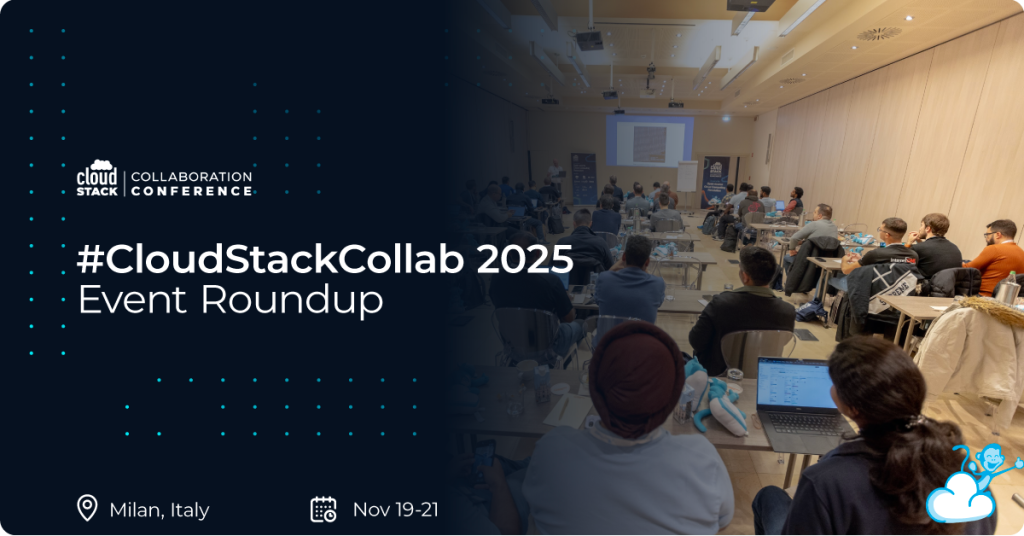
The CloudStack Collaboration Conference 2025 took place in Milan, Italy from November 19 to 21, bringing together CloudStack users, developers, and operators from across the global community. This annual in person event once again provided a valuable space for collaboration, knowledge sharing, and shaping the future of Apache CloudStack.
Hosted at the Enterprise Hotel in Milan, the conference featured a packed agenda of technical sessions, deep dive workshops, and open discussions. Topics ranged from CloudStack architecture and scalability to automation, storage, networking, security, and real world operational best practices. Attendees had the opportunity to learn directly from industry experts, exchange experiences with peers, and explore the latest developments across the CloudStack ecosystem.
We would like to extend our sincere thanks to our 2025 sponsors for their support in making this event possible. ShapeBlue, US Signal, LINBIT, StorPool, Cyso Cloud, DIMSI, CDLAN, Your.Online, Ampere, Stack Console, Yotta, proIO, and weSystems.
In this blog you will find the session recordings, abstracts, and a number of slide decks, along with a gallery of photos from the event available via the button below.
Thursday Sessions
Keynote: From Vision to Impact: Making a Difference with CloudStack – John White, US Signal
In this session, John reflected on the first year of building and scaling OpenCloud with CloudStack, the game-changing factors that made the difference, and the lessons learned along the way. Looking ahead, he also shared insights into the evolving open-source landscape, why CloudStack is well-positioned to lead in an evolving landscape, and how the broader community can continue to drive the next chapter of Open Cloud.
Keynote: Working with CloudStack for over 10 years – Wido den Hollander, Your.Online
In this keynote, Wido reflects on his CloudStack journey, shares key milestones, and highlights how CloudStack has remained a stable pillar of his company’s infrastructure for more than 10 years.
Keynote: State of the Union – Nicolas Vazquez, CloudStack VP
In this State of the Union talk, CloudStack VP, Nicolas Vazquez, takes the audience through the past year of collaboration, project developments, and community progress. He also shares his vision for where CloudStack is headed in the years ahead.
Building a sovereign, multi-zone Cloud with CloudStack – Brian Turnbow & Marco Ziglioli, CDLAN
CDLAN adopted CloudStack to build a truly sovereign cloud, distributed across its data centers in Milan and Rome, with a multi-zone architecture and multi-hypervisor support (KVM and VMware). Thanks to their pay-per-use model, their customers and partners can access scalable resources with no upfront costs, while benefiting from hybrid integration and simplified management. In this talk, Brian and Marco share how this resilient infrastructure has enabled CDLAN and its partners to accelerate the adoption of cloud services in the Italian Market.
Infrastructure Strategies and Innovation in the AI Era – Daven Winans, US Signal
This session, held by Daven Winans from US Signal, explores how infrastructure is evolving to support the growing demand for AI, large language models, and inference workloads. Daven walks through real-world performance metrics comparing CPU-only vs GPU-accelerated workloads and x86 vs Arm64 platforms. He also covers the role of open-source hypervisors, GPU virtualization, time slicing, and containerized workloads on high-core hosts — and how these approaches help improve efficiency and reduce stranded resources.
Exploring VMware to CloudStack Migration – Joffrey Luangsaysana & Grégoire Lamodière, DIMSI
This session offers a comprehensive business overview of migrating from VMware to CloudStack, examining impacts on services, cost management, and IT strategy to help organizations maximize their cloud investments.
Extensions Framework (XaaS) – Enabling Orchestrate Anything – Harikrishna Patnala & Marco Sinhoreli, ShapeBlue
In this session, Harkrishna Patnala and Marco Sinhoreli dive into the CloudStack XaaS Extensions Framework! The Extensions Framework in Apache CloudStack enables seamless integration of external services (XaaS) into the CloudStack ecosystem. It allows operators to register and manage custom extensions, supporting a wide range of types such as orchestrators, network elements, and authenticators.
Bringing CloudStack to Life with LLMs – Vivek Kumar, Yotta
Experience the power of AI-driven ChatOps tailored for Apache CloudStack. This modular Python-based chatbot, powered by OpenAI, enables users to ask natural language questions that translate into real-time MySQL queries, fetch logs from Elasticsearch, and deliver actionable insights, all through an intuitive web-based interface. With built-in memory, dynamic configuration, and intelligent log analysis, it redefines how Ops teams troubleshoot, monitor, and interact with cloud infrastructure. Watch this session to see how conversational AI can streamline your operations and accelerate problem resolution.
Back to the Origins of the Internet: Sovereignty as Strategic Survival – Alexander Lapp, proIO
In this session, Alex explores how the internet’s decentralized roots gave way to dependence on a handful of dominant platforms. He unpacks the risks of vendor lock-in, geopolitical pressure, and AI-driven cultural influence and shows how open-source tools like CloudStack enable organisations to regain true control over their data and infrastructure.
Customizing CloudStack Network Topology with VNF Appliances – Wei Zhou, ShapeBlue
The VNF appliance, introduced in Apache CloudStack 4.19, has been used by several CloudStack users as an alternative to the CloudStack Virtual Router. This talk provides an overview of VNF appliances and showcases some real-world use cases. It also introduces ongoing work on the VNF provider framework, which offers much better integration with VNF appliances. Topics includes technical details, the built-in VNF provider, and guidance on how to develop custom VNF providers.
Cost Effective, Secure Repatriation with Ampere & CloudStack – Pete Logan, Ampere
It’s established now that moving workloads off hyperscalers will reduce TCO, but you can offer more when dropping that onto Ampere CPU based systems through better efficiency and high utilisation. In this session, Pete Logan from Ampere describes how, using the joint architecture with CloudStack & ShapeBlue. Bonus; you can port your Graviton and other Arm workloads directly too!
LINSTOR/DRBD updates for CloudStackers – Philipp Reisner, LINBIT
In this session, Philipp provides a concise introduction and overview of LINSTOR and DRBD, explaining how they offer highly available block storage to VMs in CloudStack clusters. From there, Philipp presents the recently introduced features and improvements of LINSTOR and DRBD, including a discussion of the rationale behind the changes and the next items on the project’s roadmap. On the LINSTOR side, this includes: satellite restart time with thousands of resources, general scalability improvements in the range of 1,000 to 10,000 virtual volumes, and storing the master passphrase using systemd credentials (TPM chip), as well as multipathing of DRBD replication links. On the DRBD side: resync without replication, higher bitmap granularity, performance optimizations, zero-copy receive, and more. On the LINSTOR driver in CloudStack: thoughts on online migrating storage volume between primary storage.
Migrating 1000’s of VMs from VMware to CloudStack – Lucian Burlacu, ShapeBlue
Migrating thousands of VMs from VMware to CloudStack enables companies and individuals to cut costs, escape vendor lock-in, and gain operational agility. With the right automation and phased approach, large-scale migrations can be achieved with minimal disruption. This session explores some of the technical steps involved.
KVM Storage Performance: A Comparative Analysis of I/O Modes – Venko Moyankov, StorPool
Building a high-performance, cost-effective cloud requires a deep understanding of the underlying storage infrastructure. The KVM virtualization stack offers a complex landscape of I/O technologies, from traditional iothread and aio modes to the newer, low-overhead io_uring. While these options promise different levels of performance and resource utilization, selecting the optimal configuration for a given workload can be a significant challenge for cloud builders and designers. This presentation dives into a comprehensive benchmarking study designed to demystify these choices. Using industry-standard tools like FIO, pgbench, and rsync, Venko compares a range of KVM storage configurations across key metrics: latency, maximum IOPS, throughput, and CPU overhead. He provides a data-driven comparison of different I/O modes—including io_uring and its predecessors—and explores how specific configurations impact performance for diverse workloads. Watch back the session to gain the practical knowledge needed to make informed design decisions for your cloud infrastructure. It equips you with the insights to understand the trade-offs, identify performance bottlenecks, and build a KVM stack that delivers the best results for your specific needs.
Where’s my Instance? How CloudStack Finds a Suitable Deployment Destination – Jithin Raju, ShapeBlue
Apache CloudStack’s VM placement logic is powerful but often misunderstood. This session, held by Jithin Raju from ShapeBlue, explains how CloudStack selects the most suitable deployment destination across zones, pods, clusters, hosts, and storage. Jithin breaks down the roles of deployment planners, allocation algorithms, and capacity checks, and shows how these components work together to determine where a VM should run. Watch the session back to gain a clear understanding of CloudStack’s decision-making flow and to learn how to design and tune environments for predictable, efficient VM deployments.
Friday Sessions
Building OpenCloud with Apache CloudStack – David Humes, US Signal
Launching a new cloud platform is never just about technology – it’s about solving real customer challenges. In this session, US Signal’s VP of Product Development, David Humes, shares the journey of building OpenCloud, a high-performance, enterprise-ready platform powered by Apache CloudStack. Attendees hear the lessons learned from design to launch, how customer feedback shaped key features, and the tangible business outcomes customers are experiencing today. The session also provides a forward-looking view into the next wave of innovations, designed to give enterprises and service providers more flexibility, resiliency, and choice in an evolving landscape. Learning Objectives By the end of this session, you will be able to: 1. Learn from real-world experience – Understand the challenges and best practices US Signal faced in launching OpenCloud on Apache CloudStack, like customer migrations, data protection, product documentation, and more. 2. See customer value in action – Explore how OpenCloud is helping enterprises and MSPs solve issues like cost certainty, scalability, and application performance. 3. Gain a preview of what’s next – Get insight into the roadmap and how upcoming features will continue to address evolving customer needs, such the need for virtual desktops, on-premise deployments, high performance processing for LLMS and SLMs, and more.
2,800 VMs in 5 Servers: Hyperconverged Cloud with CloudStack and StorPool – Boyan Krosnov, StorPool
Traditional cloud infrastructures are complex, requiring a diverse array of components including multiple controller servers, dedicated compute hosts, dedicated storage arrays, and a complex array of network hardware. This presentation introduces a new perspective to cloud architecture. Boyan shows how to build a fully functional, professional-grade cloud with everything you need using a highly simplified design: a minimal footprint of just 3 or 5 servers and two Ethernet switches. This optimized architecture consolidates all essential functions — a highly-available CloudStack control plane, distributed software-defined primary storage, and resilient secondary storage — onto a single, streamlined set of servers. He explores how specific features of StorPool Storage enable this consolidation, eliminating the need for numerous specialized components and simplifying both deployment and ongoing operations. Watch the session back to get a clear understanding of how to build a cloud that is not only powerful and reliable but also dramatically easier to manage than traditional designs.
Building India’s Sovereign Hyperscale Cloud with the CloudStack Ecosystem – K B Shiv Kumar, Yotta
An abstract was not provided for this session.
Panel: CloudStack Exploration at Cyso – Lessons Learned and Pitfalls Encountered – Paul Bankert, Cyso Cloud
This panel discussion centres on Paul Bankert, Founder at Cyso Group, as he shares real-world experiences evaluating and operating open-source cloud platforms. The discussion explores the challenges of OpenStack adoption at scale, including operational complexity, community dynamics, and long-term maintainability, and contrasts these with CloudStack’s simpler architecture and operational model. Paul shares hands-on insights into proof-of-concept deployments, networking automation, multi-tenant and multi-site architectures, and the role of community-driven feature development. The discussion offers a candid look at how cloud builders assess platform choices, manage migrations, and balance innovation, stability, and scalability when selecting infrastructure technologies for the long term.
AI Meets CloudStack: Simplifying Cloud Operations with StackAI – Saurabh Rapatwar, Stack Console
CloudStack is powerful, but for many users, managing cloud operations can be complex. Built by Stack Console — the white-label cloud management platform for self-provisioning and billing — StackAI acts as an intelligent support agent designed to simplify and humanize the CloudStack experience. Imagine simply typing: “Create three VMs with Ubuntu 24.04 inside a VPC, assign a public IP to one VM, and private IPs to the other two, each with 4GB RAM, 2 cores, and 50GB disk.” — and StackAI takes care of the entire process. By turning natural language into precise actions, StackAI empowers users to work faster, learn as they go, and reduces their reliance on technical support. For cloud providers, StackAI lowers support overhead, accelerates customer onboarding, and delivers a more intuitive self-service experience that boosts satisfaction. With agentic AI evolving rapidly, StackAI is shaping how CloudStack can be experienced in a more accessible, intelligent, and user-friendly way.
VMware to KVM Migration Tooling in CloudStack – Nicolas Vazquez, ShapeBlue
This talk is held by Lead Software Engineer at ShapeBlue, Nicolas Vazquez. Nicolas walks through the latest state of the VMware to KVM migration tool, highlighting the major improvements made since the initial version, and shares what’s coming next for operators looking to move workloads.
How scalable is CloudStack? – Boris Stoyanov, ShapeBlue
CloudStack has always known to be scalable, but just how scalable? In this talk, Boris discusses the known and anticipated CloudStack scalability limits. He also shares design decisions that should be made to accommodate growth and uses examples of organisations running CloudStack at a massive scale.
CloudStack on LinuxONE – Stefan Schmitt, IBM
What is LinuxONE? IBM LinuxONE is a family of enterprise-grade Linux® servers, powered by the IBM® Telum® processor, that brings together the IBM expertise in building mission-critical systems with the openness of the Linux operating system. Combining these capabilities with the management and integration capabilities of CloudStack sounds exciting. And that’s exactly what IBM has done. This session explains what it means and the benefits you can gain from this combination.
Orchestrating GPU workloads with CloudStack – Vishesh Jindal, ShapeBlue
This session, held by ShapeBlue Software Engineer, Vishesh Jindal, dives into the technical design and implementation of native GPU orchestration in Apache CloudStack 4.21 on KVM, including device discovery, capability classification, and inventory synchronization via the KVM agent. By watching this session back, you will learn see how GPU‑backed service offerings are defined and consumed by Instances. Vishesh covers operator prerequisites & host setup (IOMMU, vendor vGPU profiles), and lifecycle operations from provisioning to teardown. A live demo walks through GPU discovery on host, offering creation, and end‑to‑end deployment.
Migrating Kubernetes Workloads from Azure to a CloudStack based Cloud | Christian Reichert, SC Synergy
Escaping the Commodity Trap: From Cloud Provider to Indispensable Partner – Simon Weller, UDT
In a market where Cloud offerings are increasingly commoditized, providers running on powerful platforms like Apache CloudStack have a unique opportunity to differentiate beyond price. The path to durable growth lies in leveraging CloudStack’s flexibility to elevate your role from a simple provider to a strategic partner. This session details how to achieve this transformation through deliberate innovation in your service delivery and customer support models.
Image-Based Backups with CloudStack APIs – David Humes (US Signal) & Ruben Renders (Commvault)
Enhancements on the CloudStack Kubernetes Service – Pearl Dsilva, ShapeBlue
This talk explores the latest enhancements on the CloudStack Kubernetes Service (CKS) since the 4.21 release, including: Registering templates to be used for CKS nodes, Template and service offering selection per CKS node type, Possibility to separate the etcd service to dedicated CKS nodes, Add external nodes to an existing CKS cluster, CNI configuration integration with CKS cluster deployment, CSI integration.
Cloudstack-related Infrastructure Monitoring using Grafana Stack – Kiran Chavala, ShapeBlue
Monitoring is critical for running a reliable and performant cloud environment. Apache CloudStack provides rich APIs and metrics, but turning this data into actionable insights requires a modern observability stack. In this session, Kiran demonstrates how to build a complete monitoring solution for CloudStack using Prometheus, Alertmanager, and Grafana – the Grafana stack. He walks through the architecture for collecting and visualizing CloudStack metrics, including:
- Configuring Prometheus to scrape CloudStack metrics (via API or exporters).
- Tracking VM, host, storage, and network utilization.
- Building intuitive Grafana dashboards for operators and tenants.
- Setting up automated alerts for capacity thresholds and failures.
- Viewers also gain insights into key advantages of this approach:
- Unified Visibility: Single-pane-of-glass view for CloudStack management servers, hypervisors, and system VMs.
- Proactive Operations: Early detection of capacity bottlenecks, API latency, and infrastructure anomalies.
- Scalability: Easily extend monitoring as CloudStack regions/zones grow.
- Automation-Friendly: Integrate alerts with ticketing systems or autoscaling workflows.
- Open & Flexible: Fully open-source, customizable dashboards with support for long-term metric retention.